Prof Hannan Mullet
Physiotherapy Protocols
Physiotherapy Protocols
Arthroscopic Stabilisation
Rehabilitation Guidelines: Arthroscopic Shoulder stabilisation
Prof. Hannan Mullett, Consultant Shoulder Surgeon
Arthroscopic shoulder stabilisation is a common procedure to restore shoulder stability in patients with capsulolabral avulsions without substantial bone loss.
These guidelines are designed to aid the therapist treating the patient who had an arthroscopic stabilisation procedure.
Rehabilitation considerations
Reassurance and support regarding the injury and the rehabilitation process has an impact in successful return to play following shoulder stabilisation. It is important to ascertain any fears associated with the shoulder instability and educate the patient accordingly to optimize outcome.
Phase I (Weeks 0-4)
Goals:
- Protect the integrity of the surgical repair and optimize tissue healing
- Minimise shoulder pain and inflammatory response
- Gradual restoration of passive range of motion
- Enhance scapular stability
- Prevent compensatory movement patterns that may compromise recovery
Rehabilitation
- The sling is worn for 3-4 weeks to relieve pain and to protect the repair and avoid the arm being accidentally knocked into risk positions. The sling can be removed to allow axillary hygiene and rehab.
- In patients who present with high pain levels and, or lack neutral rotation at 2 weeks post-surgery, it is important to remove the sling at this stage
- Can wean out of sling after 3 weeks if comfortable
- It is important to be aware to the ‘safe zone’ from the post-operative notes. The ‘safe zone’ positions are areas in space where it is safe to move the surgical arm, preventing significant stress on the surgical repair or injury (Funk, 2016). Generally, this is movement anterior to the scapula plane below 120 of elevation. Do not push into pain.
- Avoid combined abduction and external rotation
- Avoid forced end range mobilization especially external rotation with arm in neutral.
- Elbow/wrist/Hand range of motion and grip strengthening
- Begin shoulder active assisted / active supported range of motion (do not force any painful motion) within the safe zone.
- Rotator cuff / Scapula muscle facilitation exercises. Note that the patient requires adequate rotational range of motion before introducing active, through range cuff facilitation work above 90.
- Incorporate kinetic chain
- Heat/Ice before and after PT sessions.
Phase II. (Weeks 4-10)
Goals
- Protect integrity of the surgical repair
- Restoration functional range of motion
- Cuff recruitment and scapula control through range
- Re-educate and enhance proprioceptive acuity
Rehabilitation
Avoid passive stretching into combined abduction / external rotation. Can encourage active movement into this position provided the patient demonstrates good control and does not report apprehension.
- Progress cuff and scapula recruitment through range
- Incorporate kinetic chain
- Dynamic rhythmical stabilisation for cuff and scapula
- Closed kinetic chain work
Phase III – Strengthening (Weeks 10-16)
Goals
- Restore full active range of motion
- Optimise reactive neuromuscular stability
- Restore optimal cuff and scapula control through range and under load
- Optimise shoulder power, strength and endurance
- Return to full work, sport and recreational activities
Rehabilitation
- Regain range of motion into combined positions
- Enhance neuromuscular control through range and incorporated with kinetic chain
- Functional plyometrics
- Dynamic rhythmical stabilisation drills in risk positions
- Functional specific strengthening, power and endurance exercises for rotator cuff and scapulothoracic muscles
- Functional specific kinetic chain strength and endurance
Phase IV Overhead activity / return to work and sport (Months 4-6)
Goals
- Regain full range of motion
- Return to full strenuous work and recreational activities
Rehabilitation
- Progress strengthening as tolerated through full range of motion
- Continue shoulder stretching and strengthening at least 4 times per week
- Weight training can gradually resume with caution especially with exercises such as wide grip bench press, triceps dips, pull-downs behind the neck where the arms are repeatedly placed behind patient. Be sure to always see your elbows.
- Return to sport at 4-6 months. May initiate plyometrics / interval programme if cleared by surgeon. Incorporate return to play / contact drills
- Average return to play currently reported as 5-14 months
Physiotherapy Protocols
Latarjet Protocol
Rehabilitation Guidelines: Latarjet Protocol
Mr. Hannan Mullett, Consultant Shoulder Surgeon
Latarjet (coracoid transfer) is a common stabilisation procedure particularly in the setting of significant bone damage. It offers a robust reconstruction, with low re-dislocation rates and fairly predictable return to play.
These guidelines are designed to aid the therapist treating the patient who had a Latarjet procedure.
Rehabilitation considerations
It will take approx. 6-8 weeks to form an osseous union of the newly reconstructed glenoid, the biceps and coracobrachialis attachment to the coracoid needs to be protected during this initial postoperative period. For this reason, shoulder extension and external rotation range of motion needs to be gradually regained in a protected fashion after surgery.
The subscapularis is split to expose the joint during the Latarjet procedure. This may result in muscle stiffness and inhibition of subscapularis. In the early phase gentle soft tissue massage and inhibitory techniques can be useful to minimise the impact of this. Once strengthening commences it is important to monitor and address any deficits in subscapularis strength.
Phase I (Weeks 0-4)
Goals:
- Protect the integrity of the surgical repair
- Minimise shoulder pain and inflammatory response
- Gradual restoration of passive range of motion
- Enhance scapular stability
- Improve proprioceptive acuity
Rehabilitation
- Sling to be worn generally apart from showering and rehab. If the arm is supported i.e. sitting on a couch or desk the arm can be gently used out of the sling. Arm below elbow can be used e.g. writing, using laptop/phone. Avoid excessive passive range of motion for first 10 days to avoid haematoma formation. Can wean out of sling after 3 weeks if comfortable
- Elbow/wrist/Hand range of motion and grip strengthening
- Begin shoulder passive range of motion; forward flexion to tolerance, abduction in the plane of the scapula to tolerance
- Avoid combined abduction / external rotation
- Avoid force end range mobilisation especially external rotation
- Closed kinetic chain / proprioceptive exercises
- Cuff facilitation exercises within range outlined
- Scapula mobilisation / facilitation exercises
- Kinetic chain exercises with arm in sling to include thoracic spine rotation
- Heat/Ice before and after PT sessions. Do not force painful motions
Phase II. (Weeks 4-10)
Goals
- Protect integrity of the surgical repair
- Minimise shoulder pain and inflammatory response
- Full functional range of motion
- Cuff recruitment and scapula control
- Wean out of sling
- Begin light active, waist level activities
Rehabilitation
- Discontinue sling immobilisation fully at 4 weeks if comfortable. (wean from 3 weeks)
- Therapeutic Exercise
- 4-6 weeks: Begin gentle AAROM exercises (supine position)
- 6-10 Weeks: Progress to active exercises using gravity as resistance, shoulder flexion from supine, with trunk flexed to 45° in upright position, to standing. Begin deltoid and biceps strengthening.
- Initiate balanced strengthening. Exercises should be progressive in terms of intensity, shoulder elevation and stress on anterior joint capsule
- Scapular stability; retractors and upward rotators
- Progress kinetic chain integration
- Isotonic ER / IR at 0 degrees of abduction and scapular plane
- Incorporate specific subscapularis re-education if required
- Rhythmical stabilization drills; ER / IR in scapular plane, Flexion / Extension and Abduction / adduction at various angles of elevation
- Modalities per PT discretion, gentle joint mobilisations (grades 1& II) if ROM is significantly less than expected.
- Do not lift objects overhead with the weight of the object going behind the head i.e. keep weight in view in front
Phase III – Strengthening (Weeks 10-16)
Goals
- Normalise strength, endurance, power and neuromuscular control
- Return to chest level full functional activities
- Gradual and planned progressive load to anterior joint capsule
- Restore optimum cuff and scapula control through range and under load
Rehabilitation
- Range of motion -progress to full AROM without discomfort
- Therapeutic Exercise
- Continue and progress with Phase II exercises
- Continue with scapular strengthening; PNF with light resistance, serratus punch plus, CKC push up plus (progress from wall, counter, knees on floor, floor)
- Preparatory and reactive stabilization drills in risk positions
- Function specific plyo-metrics
Phase IV Overhead activity / return to work and sport (Months 4-6)
Goals
- Regain full range of motion
- Return to full strenuous work and recreational activities
Rehabilitation
- Progress strengthening as tolerated through full range of motion
- Continue shoulder stretching and strengthening at least 4 times per week
- Weight training can gradually resume with caution especially with exercises such as wide grip bench press, triceps dips, pull-downs behind the neck where the arms are repeatedly placed behind patient. Be sure to always see your elbows.
- Review at 4 months check xray to check graft incorporation
- Return to sport at 4-6 months. May initiate interval programme if cleared by surgeon. Incorporate return to play / contact drills.
- If satisfactory progression most athletes return to play by 6 months
Physiotherapy Protocols
ACJ Joint Stabilisation
Post Operative Guidelines –
ACJ Stabilisation- Soft tissue Reconstruction using synthetic ligament
Mr.Hannan Mullett ,Consultant Shoulder Surgeon
This surgery is undertaken to stabilise a symptomatic unstable ACJ following injury. It is an open procedure and it is vital to protect the repair
Goals
- Protect surgical soft tissue repair.
- Avoid re-dislocation secondary to failure or stretching out of the synthetic device prior to adequate healing
- Gentle stretching and regaining range of motion.
- Gentle strengthening
- Return to sports
Phase I – Joint protection (0-6 weeks)
- Patients generally wear a sling for 3-week period followed by a further period of 3 weeks when patients wean out of sling but protect it against lifting etc.
- Regular cryotherapy
- Posture awareness and scapular setting.
- Patients can use the arm below the elbow e.g. using computer, reading immediately following surgery
- Active assisted flexion as comfortable.
- Active assisted ER to 30°
- Do not force or stretch
Phase II (6-12 weeks)
- Progress active assisted to active ROM. Gradually increase ROM but do not push overhead activities
- Glenohumeral stability; sub maximal isometrics rotator cuff in neutral
- Scapular stability; serratus anterior, upper and lower trapezius strength
- Proprioception through open and closed chain exercises
- Core stability
Phase III (12 weeks +)
- Progress strengthening. Isometrics in variable starting positions progressing to resisted through range strengthening
- Sport specific rehabilitation
- Plyometric and perturbation work
Functional Milestones
- Driving -depends on side and whether automatic generally after 4-6 weeks when patient has adequate control
- Swimming – 16 weeks
- Cycling – 8-12 weeks
- Golf – 16 -20. weeks
- Rugby – 4-6 months
Physiotherapy Protocols
Rotator Cuff Repair - Small and Medium Size (<3cm)
Key Risks
- Risk of re-tear: Greatest in the first 12 weeks post-surgery. Higher risk in older patients, smokers, diabetics, those with minimal postoperative symptoms, and those with >3 cm tears.
- Risk of stiffness: Greatest in younger patients (<50 yrs.), those with PASTA type rotator cuff tears (Partial articular supraspinatus tension avulsion), those having an associated labral repair, and single tendon repairs.
Timescales are guidelines and depend on individual factors and pre-operative status. Factors that may affect progression rate:
- Pre-operative stiffness
- Age
- Tissue quality
- Associated procedures
Acute Phase (0–4 weeks)
Histology
- Peak collagen deposition and growth factors at 10 days post-op, plateau at 28–56 days.
- Requires gentle stress to guide fibre orientation but no strain.
Goals
- Protect surgical repair and optimize tissue healing
- Diminish pain and inflammation
- Gentle regaining of range of motion, respecting pain and avoiding compensatory movement patterns
- Minimise muscle inhibition
Immobilisation
- Sling worn for 2–4 weeks for comfort and to avoid stressing the repair.
- Sling removed for axillary hygiene and exercises.
- Arm can be used below the elbow (e.g. computer, reading).
Rehabilitation
- Avoid combined abduction/external rotation and forced end range stretches
- Cryotherapy as needed
- Elbow, wrist, and hand exercises
- Encourage use of hand in sling for light, unloaded, pain-free activities
- Closed kinetic chain exercises (e.g. table slides, walking away from table)
- Active assisted/active supported mobilization within pain limits
- Submaximal isometrics (<30% MVC) rotator cuff
- Active scapula exercises (e.g. shoulder shrug)
Intermediate Phase (4–8 weeks)
Histology
- Healing progressed to remodelling phase.
- Low-level force aids fibre orientation and tensile strength.
Goals
- Preserve integrity of repair
- Improve functional range of movement including full elevation
- Re-educate cuff recruitment and scapula control through range
- Improve neuromuscular control (sensorimotor/proprioceptive function)
- Emphasize normal movement patterns
Rehabilitation
- Avoid combined abduction/external rotation
- Avoid forced end range stretches
- Avoid lifting/loading until 12 weeks
- Gentle mobilization of capsular restriction if necessary
- Progress cuff and scapula recruitment through range (short lever, supine, closed kinetic chain)
- Avoid long lever open chain exercises until 12 weeks
- Progress kinetic chain integration
- Increase function with correct movement pattern
- Closed kinetic chain work to enhance co-contraction
Late Stage (8–12 weeks)
Histology
- Tendon-to-bone healing should endure initiation of strengthening exercises.
Goals
- Restore full active range of movement
- Establish optimal neuromuscular control
- Restore cuff and scapula control through range and under load
- Optimise functional upper limb strength and endurance
- Return to full work/sport/recreational activities
Rehabilitation
- Regain optimal range of motion including combined positions
- Strengthening of rotator cuff and scapular stabilisers through range
- Enhance neuromuscular control through range
- Closed kinetic chain exercises with increased load
- Functional strengthening and endurance exercises
Phase 4 – Advanced Strengthening (12–16 weeks)
Histology
- Remodeling phase close to completion; repaired tissue relatively mature and able to withstand greater stresses.
Goal
- Return to work/sport with optimal control and strength
Rehabilitation
- Progression of strength training with optimal control and movement pattern
- Sport-specific training
- Endurance training and fatigue resistance
- Promote concept of prevention
Return to Sport
Interval sports programme begins only after surgeon clearance, symmetric motion/strength, normal scapulothoracic kinematics, and no pain.
- Sport-specific training after cardiovascular warm-up (5–10 minutes).
- Programme: 3 times per week, with at least one rest day between sessions
- Maintenance programme: cardiovascular endurance, flexibility, scapulothoracic, rotator cuff, lower extremity, and core strength on alternate days.
Functional Milestones
- Driving: 4–6 weeks (depends on side and transmission type)
- Swimming: 12–16 weeks
- Golf: 16 weeks
Reference
Oliver A. van der Meijden et al. (2012). Rehabilitation after arthroscopic rotator cuff repair: Current concepts review and evidence-based guidelines. International Journal of Sports Physical Therapy, 7(2): 197–218
Large Tear Rehab Protocol
Post-Operative Guidelines –
Rotator Cuff Repair – Large tears (>3cm)
Mr.Hannan Mullett ,Consultant Shoulder Surgeon
Treatment note: Directly following the repair, integrity relies essentially on the structural construct. The conservative post-operative protocol is characterized by either a delay in the initiating of and / or restriction of passive range of motion (PROM). Remodelling repaired tissue does not reach maximal tensile strength for 12-16 weeks post repair. No formal strengthening should be performed until 12 weeks.
The risk of re-tear is greatest in the first 12 weeks post-surgery. Groups with greater risk of re-tear include older patients, smokers, diabetics, those with minimal postoperative symptoms and those with >3 cm tears.
The risk of stiffness is greatest in younger patients (<50 yrs.), those with PASTA type rotator cuff tears (Partial articular supraspinatus tension avulsion), those having an associated labral repair and single tendon repairs.
Timescales are guidelines and are dependent on individual factors and pre-operative status. Factors that may affect progression rate:
- Pre-operative stiffness
- Age
- Tissue quality
- Associated procedures
Acute protective phase (0-6 weeks)
Histology
Peak collagen deposition and growth factors 10 days post op with plateau at 28-56 days. Requires gentle stress to guide fibre orientation but no strain by limiting active motion.
Goals
- Patient education
- Protect surgical repair and optimize tissue healing
- Diminish pain and inflammation
- Prevent post-operative adhesions
- Minimise muscle inhibition
Immobilisation
- Patients generally wear a sling for 6 weeks for comfort and to avoid stressing the repair. The sling is removed to allow axillary hygiene and when patient is performing their exercises
Rehabilitation
- Avoid active assisted or passive mobilization past 90° elevation in scapula plane, 50% of ER (compared to opposite side) respecting pain and movement pattern.
- Cryotherapy as needed
- Elbow, wrist and hand exercises.
- Simple scapula exercises e.g. shoulder shrug
- Active assisted / supported movement within the safe zone and limits of pain
- Encourage use of hand in sling for light, unloaded, pain-free activities. Patients that use the hand of the operated arm during the immobilization phase have better outcomes in terms of pain and function.
- Closed kinetic chain exercises
- low load on the shoulder and ensuring congruency scapula on thorax; e.g. table slides, walking away from the table.
- Submaximal isometrics (<30% MVC) rotator cuff
- Active scapula exercises e.g. shoulder shrug
Intermediate phase (6-12 weeks)
Histology
Inflammatory and repair phase has passed and healing progressed to remodelling phase. The application of low-level force during this time frame aids in orientation of fibres within collagen matrix and enhances tensile strength of repair.
Goals
- Preserve integrity of repair.
- Improve functional range of movement including full elevation
- Re-educate cuff recruitment and scapula control through range
- Improve neuromuscular control by re-educating sensorimotor / proprioceptive function
- Emphasize normal patterns of movement
Rehabilitation
- Avoid forced passive stretching into combined abduction / external rotation. Active movement into this position is allowed as long as pain free and good control.
- Avoid forced end range stretches / mobilization especially ER with arm by side
- Avoid lifting / loading until 12 weeks
- Avoid weightbearing through operated arm e.g. getting out of a chair
- Avoid force hand behind back / extension
- Gentle mobilization of capsular restriction if necessary (respect restrictions)
- Progress cuff and scapula recruitment through range. Any exercise prescription should emphasis on good cuff and scapula control. Active assisted exercises progressing to active exercises-utilise short lever, supine and closed kinetic chain. Avoid long lever open chain exercises until 12 weeks
- Progress kinetic chain integration
- Increase function, emphasis on correct movement pattern
- Closed kinetic chain work to enhance co-contraction
Late stage (12 weeks to 6 months)
Histology
Tendon to bone healing should be able to endure the initiation of strengthening exercises. However, the addition of specific strengthening should be guided by preoperative findings in terms of tissue quality, patient age and whether primary or revision surgery. Careful progression of loading is essential to avoid compromise to the repair.
Goals
- Restore full active range of movement
- Establish optimal neuromuscular control
- Restore optimal cuff and scapula control through range and under load
- Optimise functional upper limb strength and endurance
- Return to full work / sport and recreational activities
Rehabilitation
- Regain optimal range of motion including combined positions
- Strengthening and endurance exercises for rotator cuff and scapular stabilisers
- Enhance neuromuscular control through range
- Closed kinetic chain exercises with increased load
- Functional strengthening and endurance exercises
Phase 4 – advanced strengthening (6 months +)
Histology
Remodeling phase is close to completion at 4 months and the repaired rotator cuff tissue is relatively mature, therefore able to withstand greater stresses.
Goal
Patients returning to sport or with high functional demands may require more advanced strengthening to ensure they regain maximal tensile strength and functional endurance.
Rehabilitation
- Progression of strength training with optimal control and movement pattern
- Sport specific training
- Endurance training
- Promote concept of prevention
Functional Milestones
- Driving -depends on side and whether automatic generally after 8 weeks when patient has adequate control
- Swimming 16 weeks
- Golf 16 weeks
Reference
Oliver A. van der Meijden et al (2012) Rehabilitation after arthroscopic rotator cuff repair: Current concepts review and evidence-based guidelines. International Journal of Sports Physical Therapy 7(2): 197-218
Physiotherapy Protocols
Anatomical Total Shoulder Replacement
Post Operative Guidelines –
Anatomical total shoulder arthroplasty is performed for patients who have end stage arthritis with an intact rotator cuff. The surgical approach involves a tenotomy of the subscapularis tendon which is subsequently repaired. It is important to protect the repair by avoiding loading the subscapularis by active internal rotation or excessive passive external rotation.
The given time frames are an approximate guide for progression, achieving the clinical criteria should guide the clinician and patient through this protocol.
Phase 1 – Joint protection
Aim to maintain integrity of joint while restoring passive range of motion.
- Education of patient regarding post-operative precautions and importance of adherence to and compliance with rehabilitation programme
- Allow healing of soft tissue
- Protect the prosthesis
- Reduce pain, inflammation and muscular inhibition
- Achieve AAROM up to 90° flexion, 90° elevation in scapula plane
Precautions
- Sling should be worn for 4 weeks. While sitting, keep the arm supported with a small pillow to prevent hyperextension.
- Patients can use the arm below the elbow e.g. using computer, reading immediately following surgery
- No lifting with the operated arm
- Avoid excessive stretching or sudden movements
- Avoid combined abduction and external rotation
- Avoid excessive shoulder motion behind back, especially into internal rotation (IR)
- No resisted Internal rotation
- No weight bearing through operated arm e.g. getting out of a chair or when using walking aids.
Week 1-3
- Educate patient in relation to timescales, precautions and sling management
- Frequent cryotherapy for pain and inflammation
- Introduce AROM elbow, wrist, hand exercises from day 1. Encourage light functional use of hand in sling.
- Introduce Shoulder Active Assisted Range of Movement; flexion in supine to tolerance.
- Introduce submaximal pain-free isometrics in scapular plane (<30% MVC) except IR
- Periscapular submaximal pain-free isometrics in scapular plane
Week 4
- Progress passive ROM as motion allows
- Begin shoulder active assisted abduction, ER and IR in scapular plane
- Ensure good scapular / glenohumeral dissociation. Correct abnormal movement patterns
Proceed to phase 2 if pain controlled, no signs of instability, no abnormal movement patterns, subscapularis integrity intact.
Phase 2 (approximately 4-8 weeks)
Goals
- Aim to restore passive ROM
- Gradually restore active motion
- Control pain and inflammation
- Re-establish dynamic shoulder stability with good movement patterns
Intervention
- Wean out of sling
- Continue to observe precautions
- While lying supine, a small pillow placed under the elbow will prevent shoulder hyperextension
- Avoid lifting anything heavier than a cup
- Avoid supporting body weight
- Avoid sudden movements
- In the presence of poor shoulder mechanics avoid repetitive AROM exercises / activity against gravity in standing
- Continue with passive ROM, AAROM
- Begin active flexion, IR, ER, abduction pain free ROM
- AAROM pulleys (flexion and abduction)
- Continue gentle isometrics (<30%) to include IR if pain free
- If pain is controlled and good quality of movement may begin HBB (do not force)
- Progression of scapular strengthening exercises
- Encourage functional use of arm at waist height for light tasks
Progress to phase III if pain free, well controlled functional AROM, good cuff (including subscapularis) and scapular function and good shoulder mechanics through available range.
Phase III
Goals
- Gradual return to functional activities
- Gradual restoration of strength, power and endurance
- Ensure good shoulder mechanics and movement patterns
Precautions
- Avoid heavy lifting
- Avoid weightbearing through the operated arm
- Avoid forced external rotation and combined abduction and external rotation and hand behind back
- Avoid forced internal rotation against resistance
Interventions
- Continue PROM as needed to maintain ROM
- Introduce rotator cuff resistance exercises through range (including subscapularis from 8 weeks) progress as comfort permits
- Consider deltoid rehab if poor cuff function
- Regain external rotation ROM (do not force)
- Enhance functional use of the upper limb
- Include closed kinetic chain exercises if appropriate
- Educate patient with regards long term management strategies
Functional Milestones
- Driving depends on side and whether automatic generally after 4-6 weeks when patient has adequate control
- Swimming 16 weeks
- Golf 16 -20 weeks
References
Bullock GS, Garrigues GE, Ledbetter L, Kennedy J (2019) A systematic review of proposed rehabilitation guidelines following anatomical and reverse shoulder arthroplasty. Journal of Orthopaedic and Sports Physical Therapy 49(5) 337- 346
Wilcox RB, Arslanian LE, Millett PJ (2005) Journal of Orthopaedic and Sports Physical Therapy 35(12) 821-836
Physiotherapy Protocols
Reverse Geometry Total Shoulder Replacement
Post Operative Guidelines –
Reverse Geometry Total Shoulder Replacement
Mr.Hannan Mullett ,Consultant Shoulder Surgeon
Reverse geometry total shoulder replacement is a reliable option for rotator cuff arthropathy, irreparable massive rotator cuff tears, glenohumeral arthritis and for some post traumatic conditions. Patients generally can expect significant reduction in their pre-operative pain levels and a functional range of motion following recovery. Internal rotation may never recover fully given this type of prosthetic design. Given that the surgery is generally performed on patients with severe rotator cuff deficiency there is likely to be a chronic deficit in rotator cuff strength. Improvement can continue for 18-24 months post-operatively.
Goals
- Protect surgical soft tissue repair.
- Avoid dislocation in the early post-operative period. In fact with the current generation of prosthesis the risk of dislocation with primary surgery is very low. It is higher in the revision setting. Mr. Mullett will advise if there is a higher rate of dislocation otherwise the risk is very low
- Gentle stretching and regaining range of motion.
- Gentle strengthening
Immobilisation
- Patients generally wear a sling for 4 week period
- Patients can use the arm below the elbow e.g. using computer, reading immediately following surgery
0-6 weeks
- Pendular exercises, active assisted ER to 30°
- Active assisted elevation as comfort allows
- Consider use of table slides
- avoiding forced internal rotation (v small risk dislocation)
6-8 weeks
- Gradually increase ER
- As ER increases gradually increase elevation ROM
- Active assisted exercises progressing to active exercises-utilise short lever, supine and closed kinetic chain-avoid long lever open chain exercises until 12 weeks
12 weeks +
- Isometrics in variable starting positions progressing to resisted through range strengthening
- Advance proprioceptive and dynamic neuromuscular control retraining
Functional Milestones
- Driving -depends on side and whether automatic generally after 4-6 weeks when patient has adequate control
- Swimming 16 weeks
- Golf 16 -20. weeks
- Light work (sedentary) 6-8 weeks
Physiotherapy Protocols
Anterior Deltoid Strengthening Program
The rotator cuff muscles are a group of muscles that originate from your shoulder blade and insert into the top of your humerus. These muscles are responsible for controlling the movement of your arm into elevation. If there is a large tear of these tendons, it can be difficult to lift your arm away from the body. Fortunately, there is another large muscle called the Deltoid which can be re-educated to compensate for the torn rotator cuff.
The following exercises should be done three times a day and it may take up to 3 months to feel the benefits of the exercises. The exercises start lying down flat to reduce the work against gravity and will be progressed as the strength improves. This progression will be guided by your chartered physiotherapist
Perform these exercises 10 times, 3-5 times a day. Stop exercising if your shoulder pain increases.
You should expect to see some improvement by 6 to 12 weeks.
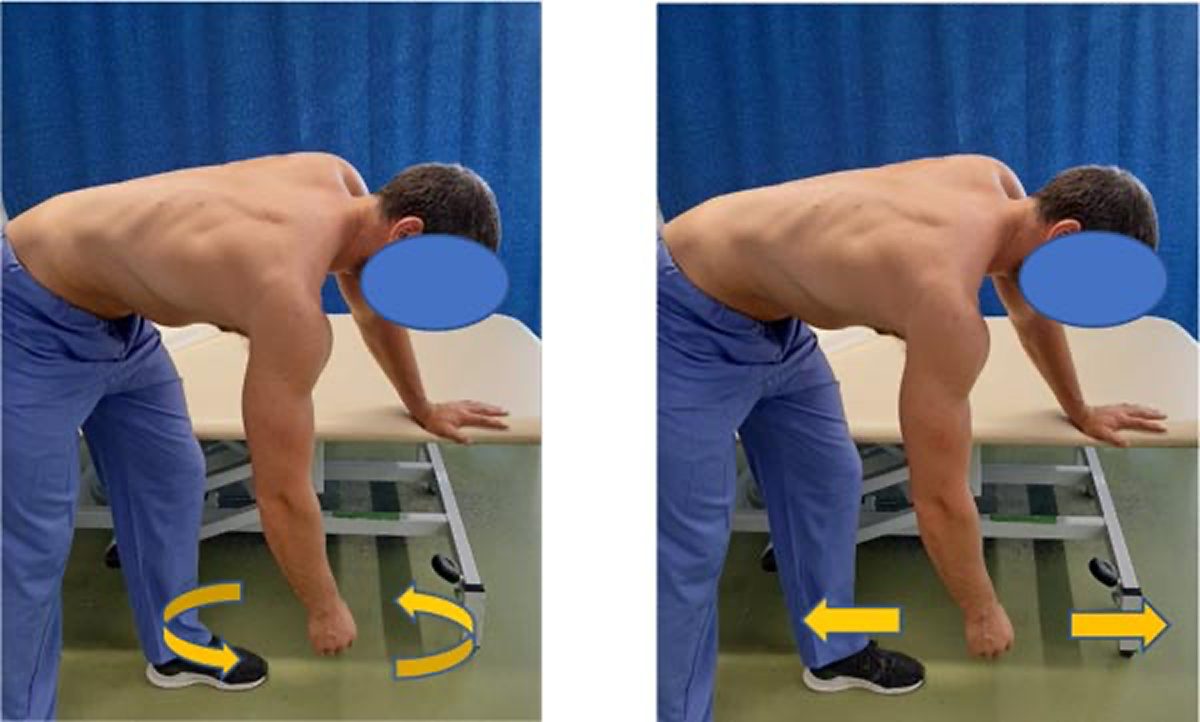
Pendular Exercises
The pendular exercises can be done as a warm up.
- Bend over supporting yourself with the good arm
- Start moving your affected arm in a circle 10 times
- Then move your arm backwards and forwards 10 times
- Next move your affected arm side to side 10 times
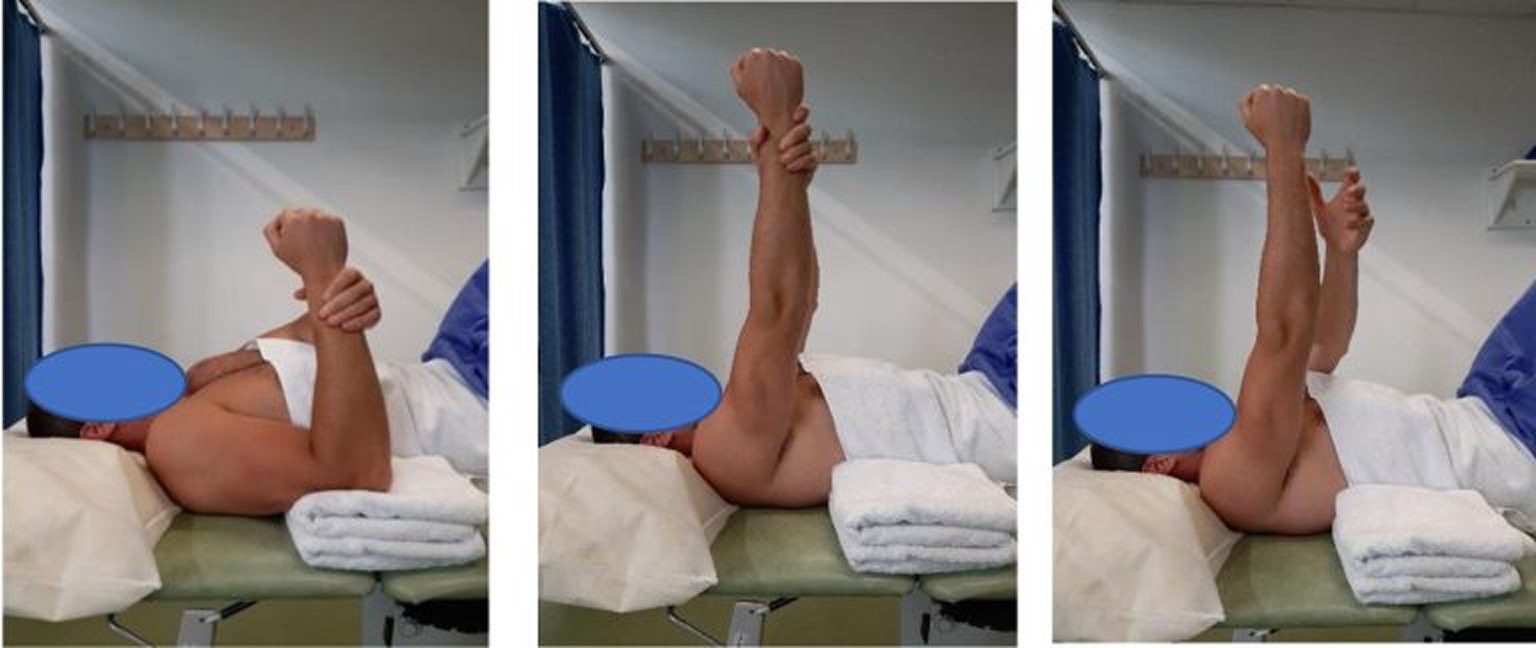
Stage 1
Lie down flat on your back, with a pillow supporting your head. Support the elbow of the affected arm on a rolled towel. Bend the elbow of the affected arm. Now raise our arm to 90 degrees vertical, using the stronger arm to assist if necessary. Once you have got to 90 degrees, you can straighten your elbow. Now attempt to hold your arm in this upright position with its own strength.
Stage 2
Slowly, with your fingers, wrist and elbow straight move the arm in small circular movements clockwise and counter clockwise. Gradually increase the circle as tolerated.
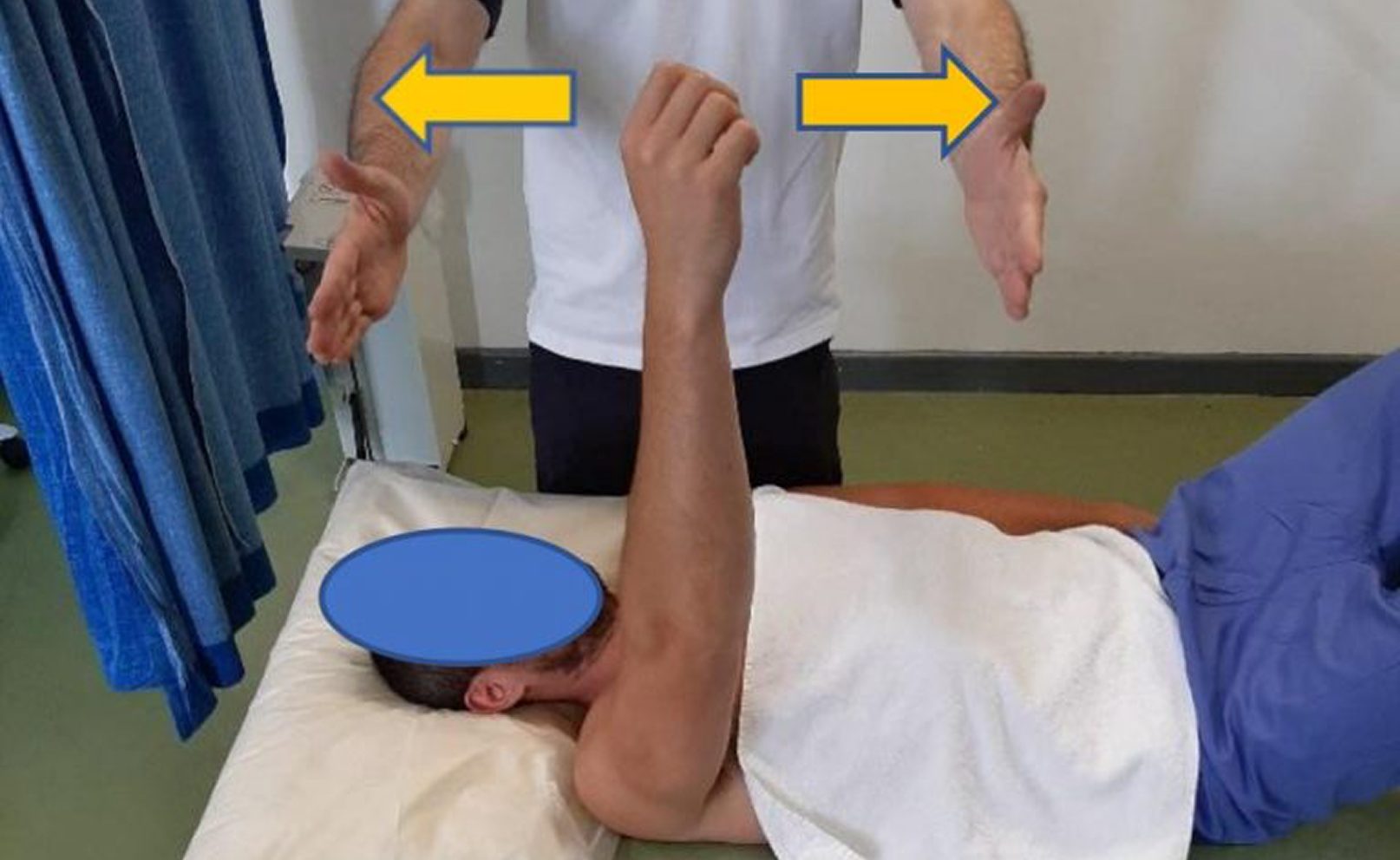
With your fingers, wrist and elbow straight, move the arm forwards and backwards in line with the outside leg. Start with a small arc of motion. Keep the movement smooth and continuous for 5 minutes or until fatigue.
As you get more confident in controlling your shoulder movement, gradually increase the range of motion until your arm will move from the side of your thigh to above your head, touching the bed and return.
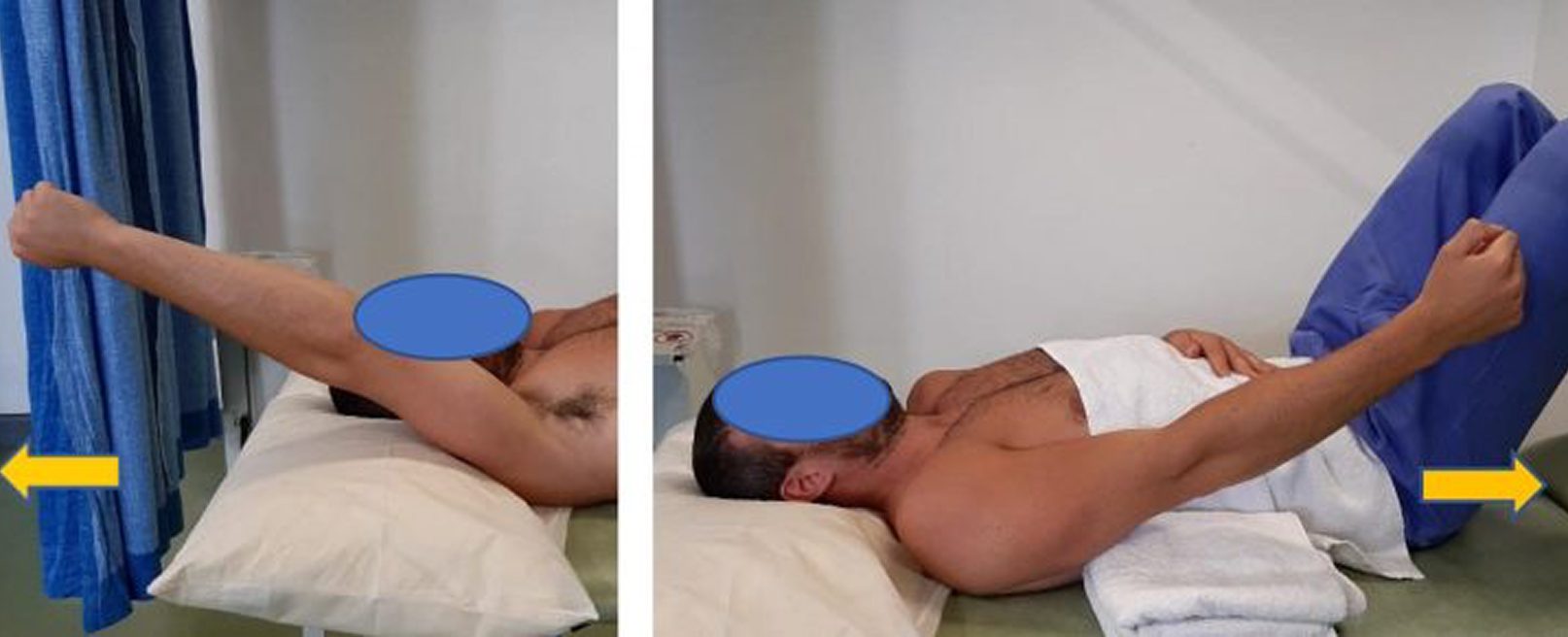
Stage 3 – Progress to light weight
As you get more confident in controlling your shoulder movement, a light weight e.g. small paperweight, should be held in the affected hand and you repeat the movement outlined above. Once you can control the movement lying flat with a weight in your hand you can move onto stage 4.
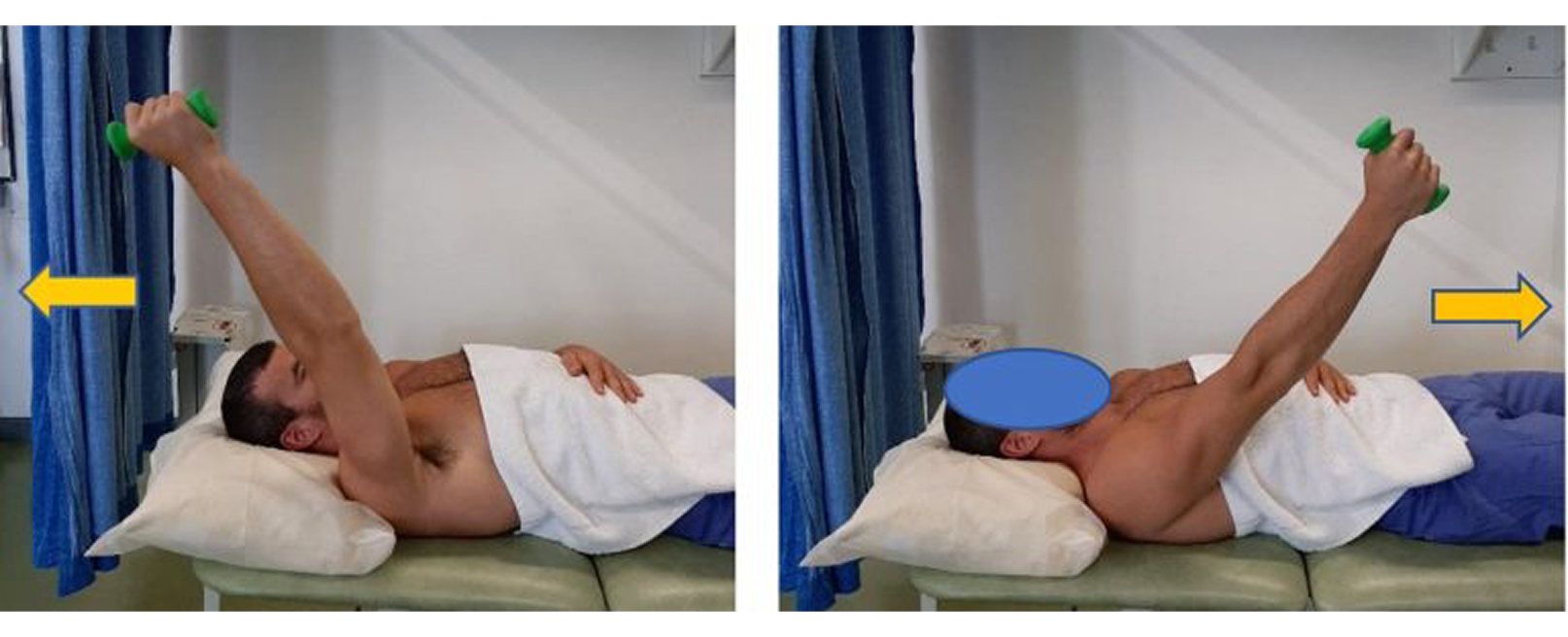
Stage 4 – Progress to an inclined position
This exercise is performed sitting up in an inclined position, using a recliner chair, deck chair or simply put some pillows underneath your back to recline your position. Repeat the exercise again, starting first without any weights and progress to use the same light weight you used before in the lying flat position.
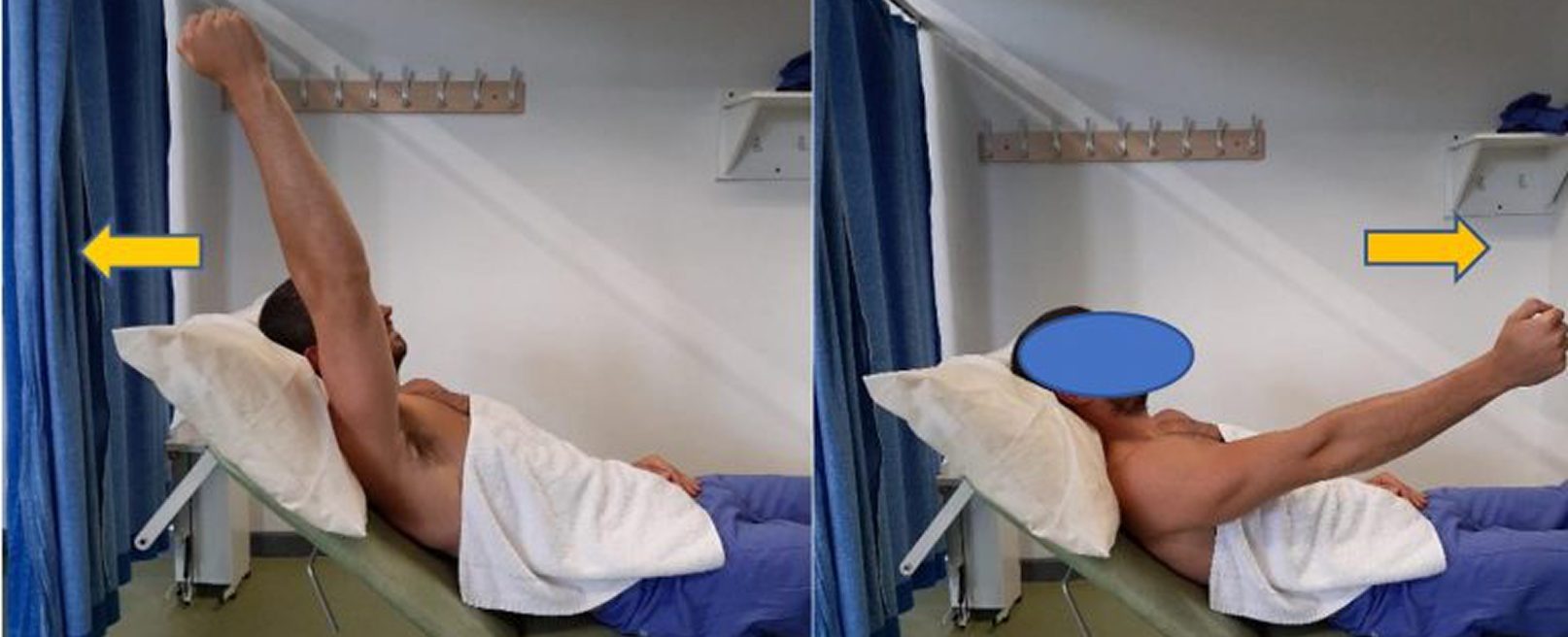
Physiotherapy Protocols
Shoulder Stretching Exercises
Physiotherapy Protocols